| Quote | Author | Source | Email Quote |
|---|
| "A startled or surprised look from one of you when I spoke sharply rebuked me more than any words could have done, and the love, respect, and confidence of my children was the sweetest reward I could receive for my efforts to be the woman I would have them copy." | Louisa May Alcott | Little Women |  |
| The expression of a man's face is commonly a help to his thoughts, or glossary on his speech; but the countenance of Newman Noggs, in his ordinary moods, was a problem which no stretch of ingenuity could solve. | Charles Dickens | Nicholas Nickleby |  |
| I go to Gascony, but my words stay here in your memory, and long after Etienne Gerard is forgotten a heart may be warmed or a spirit braced by some faint echo of the words that he has spoken. Gentlemen, an old soldier salutes you and bids you farewell. | Sir Arthur Conan Doyle | The Adventures of Gerard |  |
| I am . . . joined with eleven others in reporting the debates in Parliament for a Morning Newspaper. Night after night, I record predictions that never come to pass, professions that are never fulfilled, explanations that are only meant to mystify. I wallow in words. | Charles Dickens | David Copperfield |  |
| "And people laugh at me because I use big words. But if you have big ideas you have to use big words to express them, haven't you?" | Lucy Maud Montgomery | Anne of Green Gables |  |
| " . . . we call them dumb animals, and so they are, for they cannot tell us how they feel, but they do not suffer less because they have no words." | Anna Sewell | Black Beauty |  |
| . . . his gaze wandered from the windows to the stars, as if he would have read in them something that was hidden from him. Many of us would, if we could; but none of us so much as know our letters in the stars yet - or seem likely to do it, in this state of existence - and few languages can be read until their alphabets are mastered. | Charles Dickens | The Mystery of Edwin Drood |  |
| . . . he knew the lie of silence to be as evil as the lie of speech. | Gilbert Parker | The Battle Of The Strong |  |
| . . . it is well known to all experienced minds that our firmest convictions are often dependent on subtle impressions for which words are quite too coarse a medium. | George Eliot | Adam Bede |  |
| "Puns are the smallpox of the language." | George Meredith | The Adventures of Harry Richmond |  |
| "Really it is very wholesome exercise, this trying to make one's words represent one's thoughts, instead of merely looking to their effect on others." | Elizabeth Gaskell | Cousin Phillis |  |
| "A word in earnest is as good as a speech." | Charles Dickens | Bleak House |  |
| And whenever he spoke (which he did almost always), he took care to produce the very finest and longest words of which the vocabulary gave him the use, rightly judging that it was as cheap to employ a handsome, large, and sonorous epithet, as to use a little stingy one. | William Makepeace Thackeray | Vanity Fair |  |
| "Very foolish it is to use the wrong word to a stranger; for though the heart may be clean of offence, how is the stranger to know that? He is more like to search truth with a dagger." | Rudyard Kipling | Kim |  |
Just at the age 'twixt boy and youth, When thought is speech, and speech is truth. | Sir Walter Scott | Marmion |  |
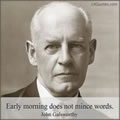
| . . . early morning does not mince words . . . | John Galsworthy | The Forsyte Saga |  |
| " . . . your words and performances are no kin together." | William Shakespeare | Othello |  |
| Then when the words were said, and man's form had tried to sanctify that which was already divine, we walked amid the pealings of the "Wedding March" into the vestry . . . | Sir Arthur Conan Doyle | The Stark Munro Letters |  |
| "It is difficult for a woman to define her feelings in language which is chiefly made by men to express theirs." | Thomas Hardy | Far From The Madding Crowd |  |
| "Vanity and pride are different things, though the words are often used synonymously. A person may be proud without being vain. Pride relates more to our opinion of ourselves, vanity to what we would have others think of us." | Jane Austen | Pride and Prejudice |  |